
In my last post, I discussed the importance of Trust in society, as well as between people. This post is going to focus on a specific cause of lower trust – income inequality. I am not going to approach this topic from any sort of a political angle. I don’t believe that a topic like trust, depression, or income inequality has any business being influenced by politics. They are far too important to fall across party lines -that would only further the current lack of trust that I mentioned in my last post.
Important Note: This post is not an inditement of Capitalism, rather an acknowledgment of a paradox.
Income Inequality: Are Our Intuitions are Correct?
There are many factors that lead to the existence of income inequality; however, I am not going to focus on those per se. Instead, I am going to focus on our intuitions. When people think of income inequality, they typically have several reactions ranging from focusing on the political implications to focusing on their own struggles. People often think of income inequality as “a shame.” This intuition is interesting. From the surface it seems logical, we want everyone to be doing well in life. However, many of us want to reach “the top” or to win. To win implies that someone has lost, or at the very least, won less. In other words, the intuition to win contradicts the want for equality.
This seems impossible, one intuition must be correct, so which one?
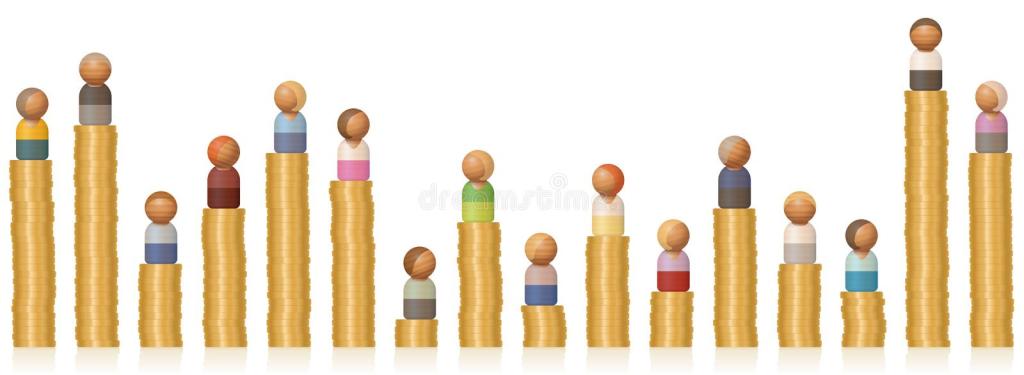
First, let’s analyze the idea that people think it’s “a shame” that income inequality exists. Going back to the work of Shigehiro Oishi, we can dig into this intuition. In a paper that focused on income inequality and happiness, Oishi looked at the United States over a 50-year time period and analyzed years where income inequality was substantially smaller. In these years, he found that, while controlling for other variables, the lower 40% of earners had higher Subjective Well Being (SWB). This was compounded by the fact that the highest 20% of earners did not see lower SWB. For the purposes of this blog, we can correlate SWB with happiness and more positive mental health outcomes (Oishi, 2018). This means that at times when people were more equal (from an income standpoint) they were also happier. The mechanism of trust explains this correlation.
In another paper, Oishi explains that “[as] predicted, Americans perceived others to be less fair and trustworthy in the years with greater income disparity, and this perception, in turn, explained why Americans reported lower levels of happiness in those years” (Oishi, 2011, pp. 1097).
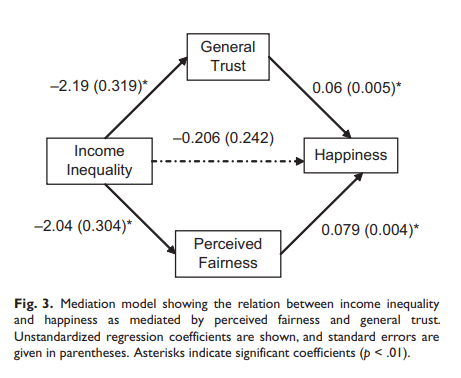
From this, it is reasonable to conclude that income inequality, by way of decreasing trust as well as perceived fairness, results in lower societal happiness. In other words, our intuition is correct.
Now let’s move on to our second intuition – the intuition to win or be competitive. This intuition implies that we need inequality as without it no one could win.
An economic study that analyzed competitiveness among both men and women, as a product of income, found that people were biologically rewarded for winning. This same study found that “the activity in reward-related brain areas not only positively correlates with higher absolute incomes but also negatively correlates with lower relative incomes” (Dohmen, 2011). This means that people want to win. They are also happier when they win (as a result of the “reward-related brain areas”). These biological tendencies match many of the core tenants of Capitalism, which emphasizes a meritocracy in its purest form. In this meritocracy, the “best” performer will win. This leads to incentives to win, as well as a belief that the “winners” are the ones with the most money. This combination of biology and market system doesn’t just lead to income inequality, it directly furthers it.

This leaves us with an interesting paradox. We need to find a way to reconcile these seemingly juxtaposed truths.
A great way to do this is to reframe them. Let’s think of them as short-term and long-term intuitions. As people, we live with seemingly contradictory intuitions all the time. I would love to binge-watch a new show every day, but I know that I will be happier in the long run if I am more productive. On a smaller scale, I would be absolutely elated to eat an entire cake for dinner tonight, but I would feel like utter garbage tomorrow. Our current problem is no different, a lot more abstract, but no different. I want to win in the short run as a result of both my genetic code and the economic system I function in. However, in the long run, I want society to be happier, because, at the end of the day, if we live in an untrusting and unhappy society, we are less likely to be happy ourselves.
The research shows that we should do our best to avoid income inequality, for the sake of the happiness of society. This is regardless of our short-term “winning” intuitions. Of course, we need to make our money to survive, but the intuition that others must lose is simply short sited. Just like many of our short-term feedback loops they come back to bite us in modern society with everything from overeating, to drug addiction, to -yes- income inequality. A key takeaway from the studies was that more income equality doesn’t lead to less happiness for the top earners, just more happiness for the less fortunate.
Citations (if people would like to learn more about the above topics, they can use the following papers)
Diener, Oishi, S., & Lucas, R. E. (2003). Personality, Culture, and Subjective Well-being: Emotional and Cognitive Evaluations of Life. Annual Review of Psychology, 54(1), 403–425. https://doi.org/10.1146/annurev.psych.54.101601.145056
Dohmen, & Falk, A. (2011). Performance Pay and Multidimensional Sorting: Productivity, Preferences, and Gender. The American Economic Review, 101(2), 556–590. https://doi.org/10.1257/aer.101.2.556
Hagerty. (2000). Social comparisons of income in one’s community: Evidence from national surveys of income and happiness. Journal of Personality and Social Psychology, 78(4), 764–771. https://doi.org/10.1037//0022-3514.78.4.764
Oishi, S., Kesebir, S., & Diener, E. (2011). Income inequality and happiness. Psychological science, 22(9), 1095-1100.
Oishi, S., Kushlev, K., & Schimmack, U. (2018). Progressive Taxation, Income Inequality, and Happiness. The American Psychologist, 73(2), 157–168. https://doi.org/10.1037/amp0000166



 Denali Keefe